(Content modifed: October, 2025)
(File modified: October 13, 2025 5:24 pm)
This site works better with Javascript enabled.
Michael J. Hannah, Los Ranchos, NM.
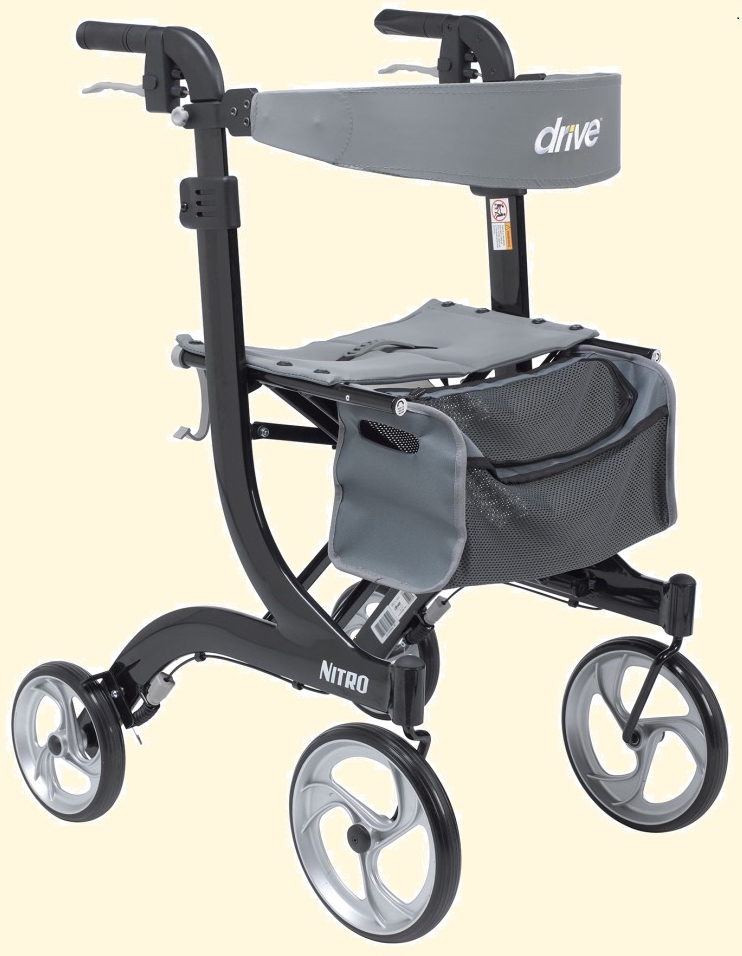 My experience with the Drive™ Nitro rollator
for use with my sIBM condition
I purchased1 a Drive™ Nitro (Tall, Black) in October 2018 two years after my diagnosis with Sporadic Inclusion Body Myositis (sIBM) for use when I am out and about in town. After seven years of frequent use I am generally pleased with the Nitro and its portability. I now have two, one in the house and one which stays in my car for when I go out, each with their own seat cushion. Although I continue to use an Alinker which I feel is a safer device for exercise walking, while I am still able to walk carrying my weight I have found my Nitro very helpful not only as an easily portable walking aid when I am out, but especially as a transportable raised height chair with arms, and even as a tea trolley.
Since my progressively declining sIBM stage still2 allows me to stand and walk carrying my weight, a rollator continues to be an option for me. The Nitro has both characteristics my physical therapist recommended in any aid for such walking, especially with my sIBM condition. First, she recommended a rollator which will simply roll along as I walk with a continuous gait, rather than a walker which generally requires being lifted or pushed out in front and then walking up to it thus interrupting the gait. As sIBM further weakens my hand and arm strength, lifting and pushing a walker is an issue for me which a rollator does not require.
My physical therapist also recommends trying to maintain an upright posture when walking as important to my overall body strength and health. Some rollators like the Nitro allow me to stand upright within the rollator with my arms straight down where they can somewhat support my weight at all times, whereas a walker is generally not supporting my weight at all when I am moving it and often encourages a bent-over posture. Because the Nitro comes in three heights, and each model is adjustable within its range of heights, it can be set to allow me a position of standing straight up with the hand grips at a height where my weight can be somewhat supported on unbent arms. I believe that this position is better for me because my condition is sIBM. The uniquely sIBM “leg buckle” causes a person to fall directly down instead of losing their balance and falling over. I am convinced this upright position with weight supported is more likely to allow me to catch myself “when” this buckle happens and thus not fall completely to the ground.
UPDATE: Unfortunately by this time I have fallen, more than once, while using the Nitro. While I could hold on to the Nitro when a leg buckled, neither my legs nor my arms had enough strength to avoid falling to the ground. While holding on did allow me to fall slower with some control, I did still fall completely to the ground with some, but lessened, injuries. Hence I became interested in the LifeGlider rollator now reviewed in a companion post on this site. Although I still use the Nitro for its many purposes.
Depending upon one’s amount of muscle atrophy from sIBM, rising from the low height of an ordinary seat, especially from one without arms like a bench, can be anywhere from difficult to impossible without help. Further due to the weakened leg muscles lowering can be somewhat out of control (often resulting in what is called the sudden IBM “plop”) with concern for the sturdiness of the seat. Being six feet tall both of these issues had progressively discouraged me from going out to public venues (like restaurants, concerts, etc.) which often only have low seating, and even made me hesitant to visit the homes of friends. However like many rollators the Nitro has a built-in seat, and because it is somewhat collapsable it is easy to put in the car. When “locked” with its brake to prevent moving, the seat on my “tall” Nitro with arms provides a chair at a height which I can still rise from without help. While its built-in seat is not sufficiently comfortable to sit in for any length of time, I obtained a thick soft 18” x 18” cushion which both fits the seat, and can be stored in the Nitro’s built-in storage pouch when walking. As a result I now can go out to a restaurant or concert and visit friends as I can take my own armchair with appropriate seat height. Further I am also more confident in walking into and out of these unfamiliar places using the rollator. As a result it is not an “extra” device to take with me. The only “down” side is that the Nitro’s arms cannot move out of the way when seated at a table, and can somewhat interfere with activities on the table such as eating or playing cards. However, knowing that when I arrive wherever I am going I will have at least this “chair” which I can use adds greatly to my confidence and enjoyment.
I have discovered that the Nitro can be used like a tea trolley which allows me to transport items around the house while at the same time using the Nitro to walk there. I purchased3 an appropriately sized ordinary cafeteria tray. It needs to fit in the full 18” width across the seat so that it rests on the front-to-back rods which brace the seat. The tray is then at a comfortable height where I can place most anything on it and then roll to wherever I am going. And when the items are removed the tray fits easily sideways in the Nitro’s built-in storage pouch. I find that using a tray like this can help to overcome the significant limitation on carrying things when using a rollator due to needing to hold it with both hands.
Endnotes
2. Ultimately my muscles will become so weak that I will not be able to use a rollator and will require a motorized wheelchair.

Disclaimer
This document simply expresses my personal opinion. I am not affiliated with Drive™ in any way and do not claim this is the “best” rollator for use by someone with the medical condition of sIBM. I simply report that I choose to use it and find it useful. Any use of this device is obviously at the user’s own risk.
As described in a separate document, this document was composed with Adobe® FrameMaker 2019®, converted using its hyperlink and "Save as HTML" features, post-processed with my custom Perl© script, linked to my Responsive CSS file which references my fixed set of fonts, and the HTML and CSS are W3C validated.
©MJH Consulting, 2020-2023. All rights reserved.
 (Content modifed: October, 2025)