The Alinker® as a rollator for sIBM ©MJH 2020-2023
(File modified: November 5, 2023 11:46 am)
This site works better with Javascript enabled.
Michael J. Hannah, Los Ranchos, NM.
The Alinker® as a walker rollator for sIBM
Why I customized it and use it for exercise walking
The Alinker gave me back the joy of walking
by removing my fear of falling!
[See Updates section. Latest entry is June 2023]
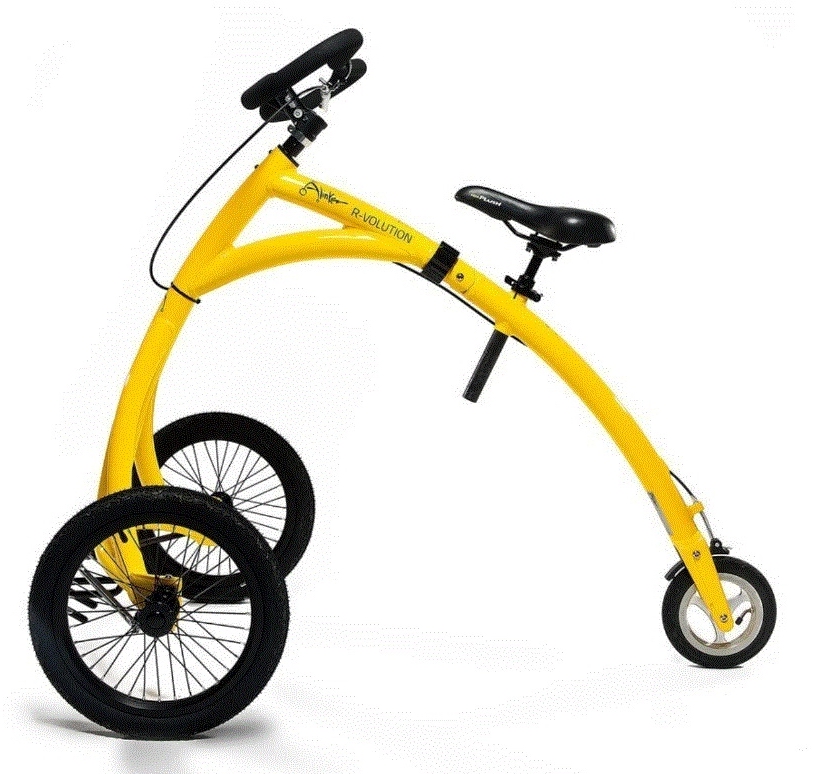
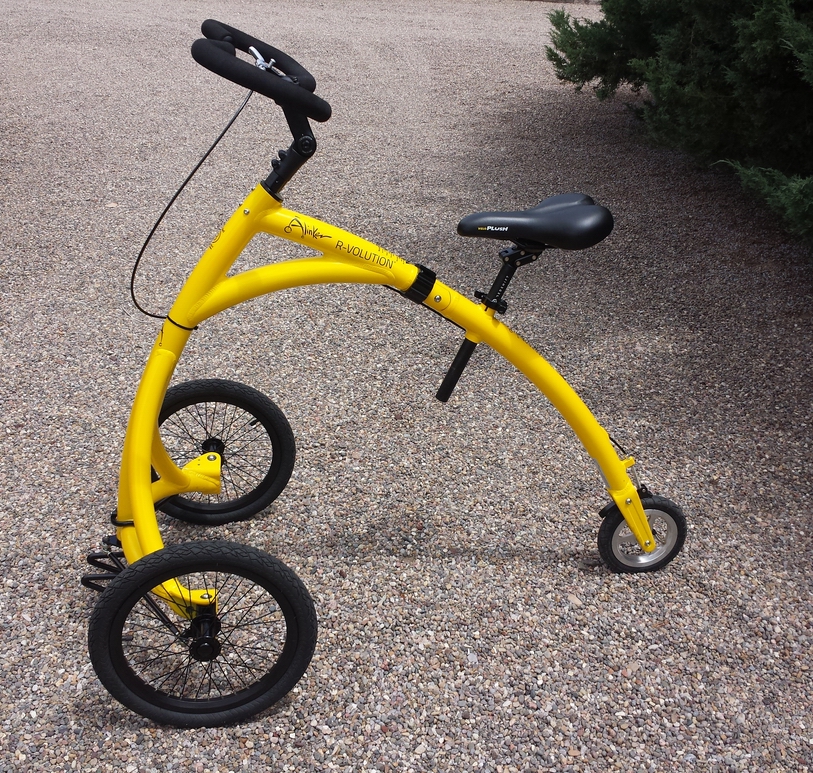 On the left is the standard Alinker™ R-volution walking bike. On the right is my customized Alinker. Can you see the difference? Look closely at the seat and handlebars. My seat is moved back and tipped level, and my handlebars are rotated to the front. This leaves more room between them. Why did I make these changes to the Alinker to use it differently than it is designed to be used? (Not simply because I am a retired engineer compelled to re-engineer most everything 😄️). Read on.
The Alinker is designed for people to be mobile by using their legs to walk while sitting, and still allow them to be at eye level. It seems most often used by people who have problems standing and walking without support, but would prefer not to use a traditional medical device such as a wheelchair, walker, or rollater. While the Alinker does not identify itself as a medical device, there are many testimonials of people with various medical conditions who say they much prefer an Alinker to the more typical devices, at least in some circumstances. Wheelchairs, walkers, and other such devices are awesome for people who need them! But it seems, for example, that half of the people using a wheelchair can still (at least somewhat) use their legs, and may benefit from that exercise.
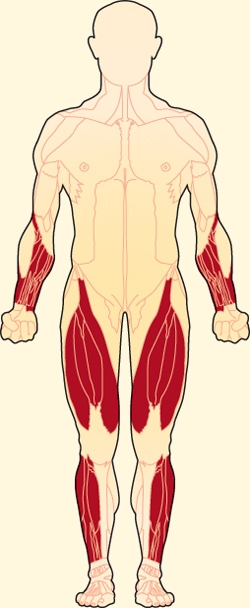 While these testimonials of people with various conditions successfully using an unmodified Alinker were encouraging, they did not seem to apply to my medical condition. I have been diagnosed with Sporadic Inclusion Body Myositis (sIBM). This rare condition, recognized by the Muscular Dystrophy Association, causes a steady and progressive atrophy of the muscles, generally starting in the quadriceps and forearms. There is no known cause, cure, or treatment, although there is some evidence that appropriate exercise seems to slow down the rate of decline in some patients.
Like many at my earlier stage of sIBM I remain able to walk somewhat as my legs can still support my full weight. However those of us with sIBM become progressively susceptible to falls, which potentially can be very dangerous. For most (non-IBM) people falls are caused by a lack of balance which results in tipping over like a tree falling. In these cases hanging on to a walker or rollator, or even just a cane, can often allow them to regain their balance and catch themselves from falling. Unfortunately sIBM will cause our weakened leg muscles to suddenly collapse, initially sending us straight down and then abruptly toppling into the ground. For this reason I felt many walkers or rollators would be of little help in preventing me from falling in this situation, as my canes did nothing to prevent me from falling straight down and into the ground! 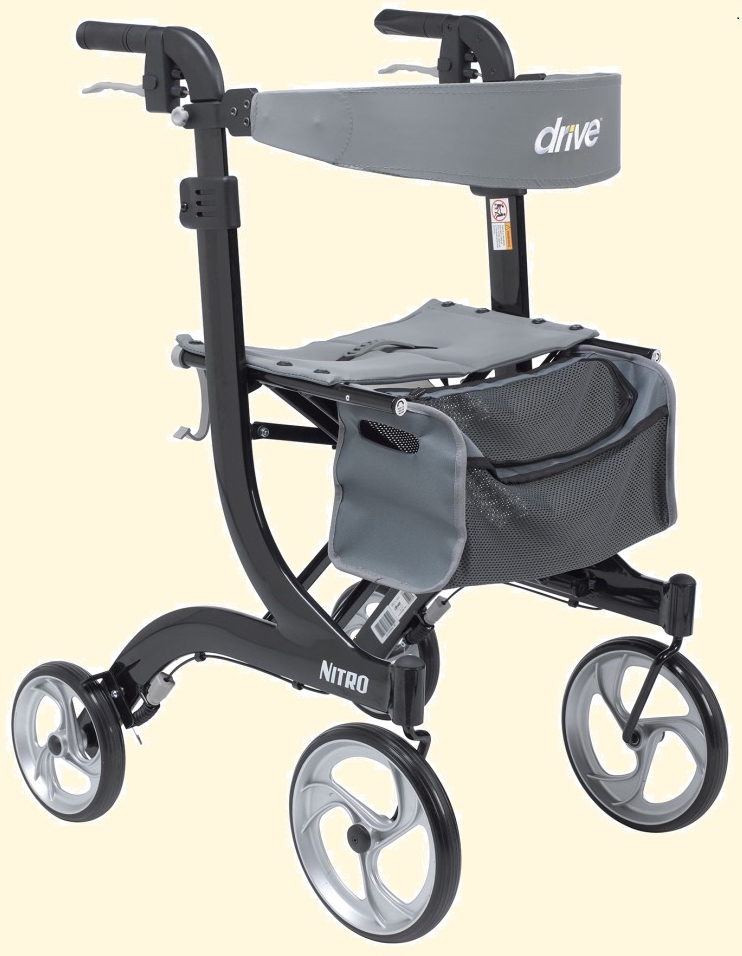 While I also use a Drive™ Nitro rollator whose design helps somewhat concerning possible falls, I felt preventing a fall was especially an issue for my exercise walking as I am less focused on keeping my balance, and am stressing my muscles to where they may be more likely to give out.
 My physical therapist encourages standing and walking on my legs carrying my full weight as valuable exercise, not only for these ever weakening muscles but also for my whole body. However, even with canes or my Nitro rollator my fear of falling discouraged me from this as exercise except in limited safe environments. The Alinker is designed to be used sitting with your body weight supported, like on a bike. But while it is easy to sit, with sIBM the weakened leg muscles make it hard to push back up to stand, which motivates remaining standing. In May 2020 I decided to purchase an Alinker to use instead while standing and exercise walking, even after using my Nitro rollator for two years. I reasoned that if I was walking while directly above the seat and my legs gave out, I would initially drop straight down and simply abruptly sit rather than fall down. I have come to believe an Alinker (customized or not) may be an ideal aid to the specific type of fall caused by sIBM, but I have not (yet) had my legs give out while using my customized Alinker. (Even when I am no longer able to carry my weight on my legs I plan to continue to use the Alinker for exercise walking, but will do so while sitting.)
 Unfortunately since it is designed for sitting, the seat (usually called a “saddle” on a bike) is positioned sufficiently forward to interfere with where one would wish to stand and walk. Fortunately Charlie at my local bicycle shop informed me that some bicycle enthusiasts like to be able to adjust the position of their seats forward and back while on a long ride. There exist various custom bicycle seat posts which can move the seat backwards and forwards as desired.
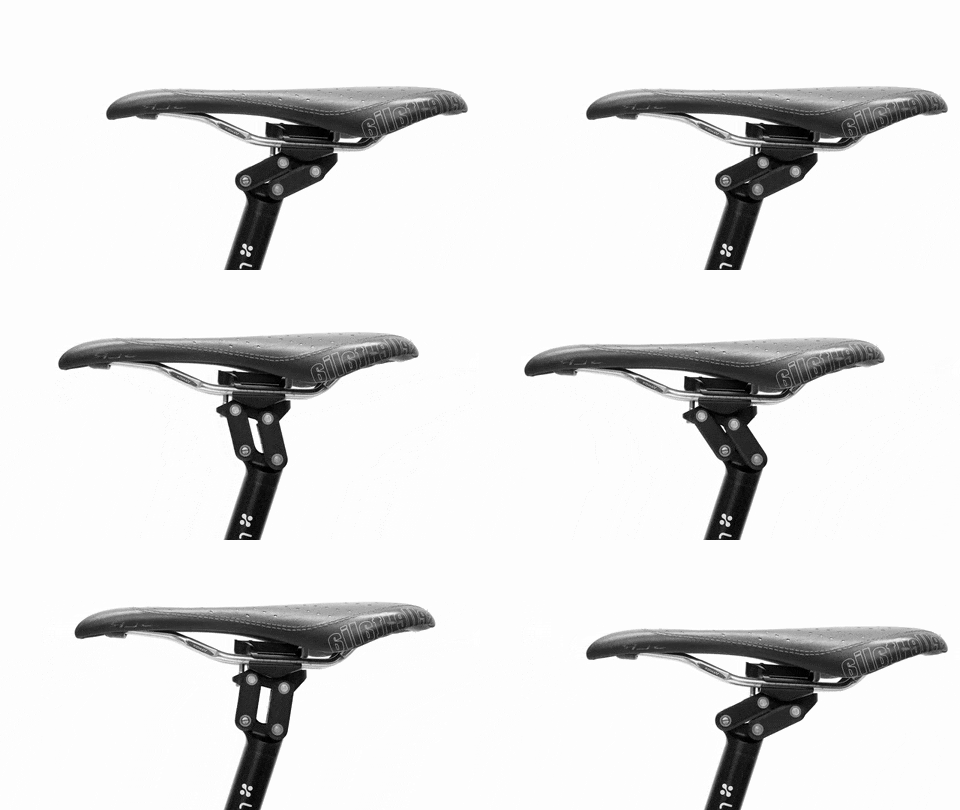 The one I found was the “Dual-Position Seatpost” made by Redshift Sports. Like the Alinker it was designed and manufactured by a small group, and originally brought to market by crowd-funding. In July 2020 I installed this custom post with its mechanism on top which allows the seat to be pushed into two different positions. Forward puts the seat in the normal position for riding when sitting upright. The back position is intended for when one is pedaling crouching forward and down. The distance between the two positions is not all that great, however I have found it moves the seat far enough back to now provide me enough room to stand and walk. And if I want to sit upright and walk the bike as intended, I can simply tug (stiff but not hard) and click the seat forward to its forward riding position. The diameter of this post is identical to the post that comes with the bike, so it just swaps in. It is available from a number of places on-line, but I bought mine at the Take A Hike Shop located in Missouri where I went to graduate school.
As you can see by comparing my customized bike to the manufacturer’s picture at the top of the page, this custom seatpost allows the seat to be further back and be adjusted tipped down in the front to leave room to stand. 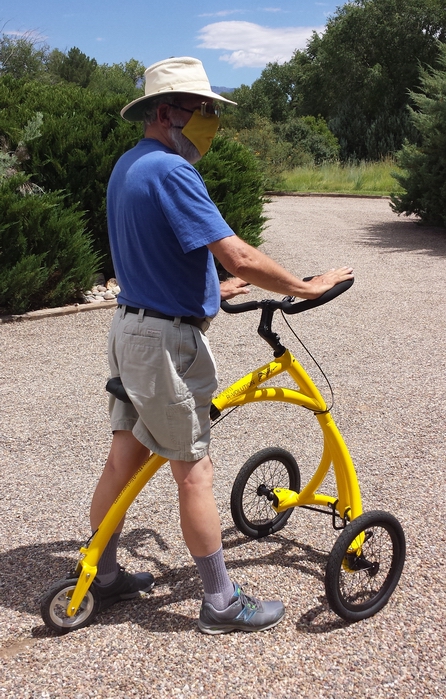 Notice how I can be upright and walking, with plenty of room but with the seat right up touching my rear end so if I drop it is not very far. [Hint! Right-clicking on any picture should allow most browsers to display a larger image.]
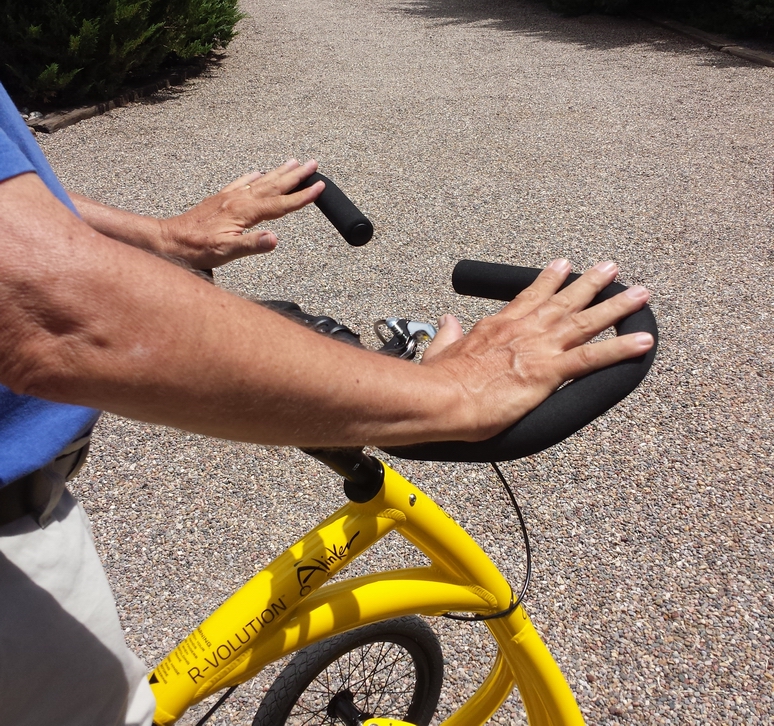 An additional advantage is that the Alinker handlebars can be rotated to the front. (The brake lever then needs to be relocated next to the shaft and the handlebar cover shifted around some, but that is relatively easy to do.) This modified Alinker with rotated handlebars versus a traditional rollator I think provides greater ease on the hands for people like me with sIBM. A walker must be “gripped” by the hands to pick it up and move it, or a rollator pushed along with the hands. Since sIBM causes the hand and grip strength to deteriorate, I expect it will become difficult for me to grip or operate either a walker or rollator. But with the Alinker I can already just lay my hands flat on the handlebars without gripping, where it takes very little effort to steer or push the bike along.
What are the down sides to an Alinker as a high-end rollator? Well, first it is not cheap. However if its purpose is exercise, its cost is not a lot different than a high-end stationary bike or treadmill. And I find it much nicer to exercise outdoors where I can greet the neighbors. Further if you consider the out-of-pocket expenses which a fall may incur, its presumed preventative value may well be worth it. And there are sometimes “gently used” Alinker bikes available from prior users, at times advertised through the Alinker site.
One advantage is that the Alinker easily folds up, and with quick release systems both the wheels and saddle post can be removed. While it therefore can be transported, it is a significant piece of hardware at about 26 lb. for an assembled Medium. While that sounds heavy, when I reach the end of the street I can easily pick it up while straddling it and turn around in place. (Of course I can just walk it around in a circle.) The total weight of the front wheels, the steering and the saddle is just over 5 lb. so when lifting the disassembled Alinker without them into the car, it is less than 21 lb. This YouTube link begins a set of short video clips by the manufacturer showing how quickly one can disassemble it, put it in a car, then take it out, and put it together again ready to go. It is not something I currently choose to pop in the car for use on short errands around town. For that I typically use my Nitro rollator described in a separate page. But I might take it with me where I intended to stand and/or walk for some while. Wherever you take it, just like a walker or rollator it does work best on flat hard surfaces, especially if weakened legs make climbing an incline an issue, although I find I can easily walk it across the gravel driveway to the street.
As for using it as a rollator, it did require continual early adjustments of the seat and handlebars to get everything comfortable for me. While it takes some practice to learn to walk normally rather than the tendency to walk bow-legged with the big bar between your legs, I have gotten used to it and now find it easy to walk briskly with confidence for exercise. Originally I was unsure but have since found the supplied seat/saddle appropriate with the custom seatpost. With the seat clicked back and positioned all the way up touching my rear end (but not supporting my weight), it does not interfere with normal walking even with lengthy strides. But any lower it would be in the way. With the saddle nose already between my legs I am positioned fully on the seat, thus feel confident I will simply be sitting should my legs give out. And if I get tired (or want to stop and talk with a neighbor 😄️) I can comfortably sit for a while with the seat clicked forward.
As I continue to use the Alinker over time I will (try) to update observations about my use.
Since I first posted this I have learned the “correct” term for how I use the Alinker is “rollator”. Walkers don’t roll, they need to be either slid or lifted for movement. Rollators have wheels to roll, are pushed not lifted, and often come with seats. Hence it is more accurate to say I currently use the Alinker as a “rollator”.
Unfortunately I have found the supplied seat far from comfortable for any length of sitting, especially for a sensitive elderly male. Using it as a rollator means I am not sitting on it all the time, so the supplied seat works well for that use. But as I expect my leg muscles ultimately will no longer support my weight, I have searched for a replacement seat. Generally alternate seats with a short or no “nose” and more cushion tend to be wider both front-to-back and side-to-side. Wider front-to-back defeats the advantage of the dual-position seatpost by encroaching on the space in front of the seat, so I plan to reserve this alternate seat for when I am only sitting. While a wider side-to-side seat can make it harder to walk up on it from behind without having to (somewhat) swing the leg over, 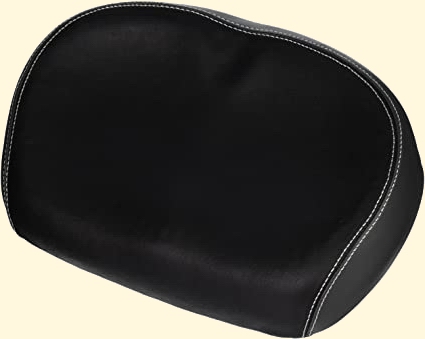 I have found one which I find a good compromise. I purchased the Schwinn Comfort Bike Noseless Foam Saddle which I mounted on the supplied post (since the supplied seat is mounted on the custom dual-position post). I can simply pull out one post and put in the other with their attached saddles to change seats. I find this seat to be extremely comfortable when positioned correctly for sitting all the time as the bike is designed to be used.
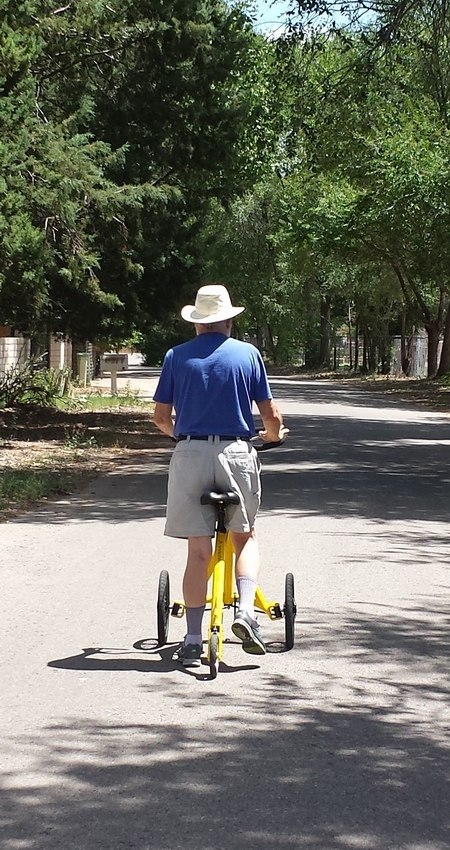 All minor complaints aside, while these customizations are unlikely to be appropriate for general use of the Alinker, my regular current use is exercise consisting of standing and walking. I have been using it for a daily mile-long exercise walk for over a year now and find these modifications very successful in permitting that activity. It has been a real pleasure to take regular brisk exercise walks, at eye-level with my spouse, with increasing confidence and much less fear of falling. When it becomes necessary to always be sitting (as the Alinker is intended to be used), I expect to just use the standard seatpost with the alternate noseless saddle mentioned above which I believe will be very comfortable.
I have now used the Alinker nearly every day for three years. My physical therapist has other patients who also have IBM and remarks that I am showing the slowest decline. Among other things she believes this is greatly helped by my using the Alinker for daily exercise walks. She actually did my annual testing of my walking ability when on the Alinker because she observed I can walk with it in my rollator configuration at full speed, with full use of my leg muscles, and my legs carrying my full body weight, without fear of falling. I can’t say enough about how my exercising with the Alinker has slowed my decline.
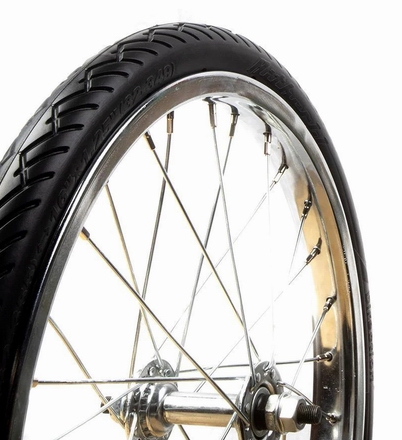
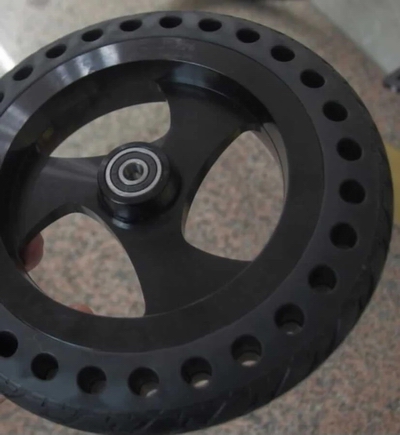 I finally became sufficiently annoyed at having to pump the tires back up after slow leaks and punctures that I changed to solid tires. I did order and (finally) obtain a solid rear tire from Alinker (shown on the right). While they do not stock solid front tires, they recommended the Black Tannus Solid Airless mini-velo tires, 16”x1.25” which fit 17-20 inner rim width. I purchased two of these tires (shown installed on the left) from a local bike shop which carries Tannus products. The shop installed them on the Alinker front wheels and they fit perfectly. I watched the installation which was not easy, and in my opinion should only be done by a professional with appropriate tools. The Alinker rides some rougher and a tiny bit lower now so I had to slightly raise the seat, but otherwise all is well with no more pumping tires!

Disclaimer
This document is strictly my personal opinion. I am not affiliated with the manufacturer in any way and do not claim this is the “best” or even an appropriate use of the Alinker® bike by someone with the medical condition of sIBM. I simply report that I choose to use it this way and find it useful. Any use of an Alinker® either as shipped or with my chosen customizations is obviously at the user’s own risk.
As described in a separate document, this document was composed with Adobe® FrameMaker 2019®, converted using its hyperlink and "Save as HTML" features, post-processed with my custom Perl© script, linked to my Responsive CSS file which references my fixed set of fonts, and the HTML and CSS are W3C validated.
©MJH Consulting, 2020-2023. All rights reserved.
 (Content modifed: July, 2023)